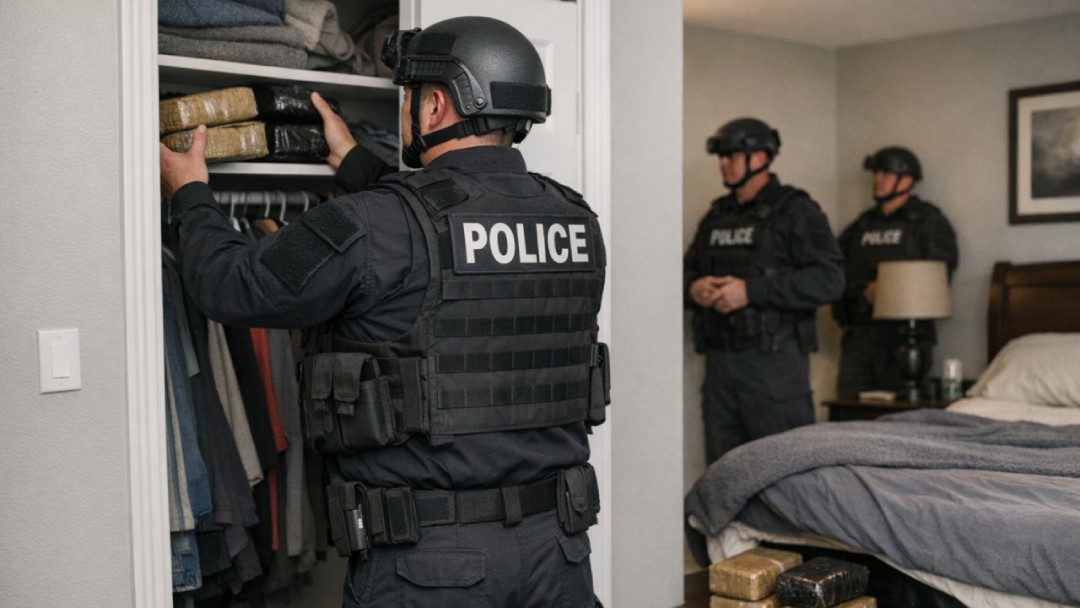
Recently, over lunch, Bobby Byrnes and I got to talking about our careers, both starting as police officers in the early 1990’s. We had 25 years plus of teaching together and also worked on many cases from investigation to prosecution-murders, cartel level drug cases, identity theft, money laundering, and cases that involved combinations of the crimes. Gangs, guns, and drugs go hand in hand. It did not take long before the conversation moved to one of the biggest challenges to law enforcement: constructive possession. The conversation did not focus on the easy and simple cases, but rather the messy situations where nothing is in plain sight, property is not in the name of the offender, and everything depends on what you can prove about control and knowledge. We have long realized that between the both of us-coming from the investigative side, and from the prosecution-that we had seen just about every way that these cases can go right or wrong. We made the decision to put their thoughts down on paper and lend some guidance to law enforcement. It was our goal to put together a practical look at how constructive possession actually gets built, challenged, and decided in the real world.
Constructive possession remains one of the most litigated and misunderstood concepts, especially in cases involving firearms, narcotics, and other illegal items. Unlike actual possession, where the contraband is found directly on a person, constructive possession requires proving that a suspect had both knowledge of the item and dominion or control over it. Think of it like your car parked in the garage, or your money in the bank. You are not in actual possession of it right now, but it is yours.
Courts across the United States consistently emphasize that proximity alone is not enough. Officers must build a layered, evidence‑driven case that ties the suspect to the contraband through behavior, statements, forensic evidence, and the totality of circumstances.
Establishing constructive possession is often challenging precisely because criminal offenders go to great lengths to conceal their illegal activity. Sophisticated offenders routinely structure their living arrangements, vehicles, and property ownership to avoid direct links to contraband. Leases, mortgages, and vehicle titles are frequently placed in the names of significant others, relatives, shell entities, or other third parties. Vehicles often contain multiple occupants, residences may house multiple and often unrelated adults, and contraband is commonly hidden in concealed or shared areas. Contraband is rarely strewn across the trunk or floor of a car; since, by their very nature, such goods must be withheld from public view, they rarely can be placed in an automobile unless they are enclosed within some form of container. United States v. Ross, 456 U.S. 798, 820 (1982). Courts recognize these realities, but they also require officers to articulate evidence showing knowledge and control beyond mere presence. Henderson v. United States, 575 U.S. 622 (2015); United States v. Jenkins, 566 F.3d 160, 169 (4th Cir. 2009).
In today’s policing environment, where body‑worn cameras, forensic DNA tools like STRmix, and detailed documentation practices are standard, officers have more opportunities than ever to establish constructive possession-if they know how to use these tools effectively, document and articulate their significance clearly.
Understanding Constructive Possession
Constructive possession generally requires proof of two elements:
- Knowledge: The suspect knew the contraband was present.
- Dominion or Control: The suspect had the ability and intent to exercise control over it.
Courts look for evidence that links the suspect to the item beyond mere presence. This is especially important in shared spaces, such as vehicles with multiple occupants, homes with several residents, or jail cells with multiple inmates. When control of the location is not exclusive, courts require additional independent evidence connecting the suspect to the contraband. United States v. Perez, 661 F.3d 568, 576 (11th Cir. 2011); People v. Wise, 2021 IL 125392, ¶¶ 30–35.
Ownership is not required to prove constructive possession. A defendant may exercise dominion and control over contraband even when they do not own the vehicle, residence, or container in which it is found. State v. Hankerson, 70 Ohio St. 2d 87, 91 (1982). However, the absence of ownership documentation increases the importance of behavioral, forensic, and circumstantial evidence.
1. Body‑Worn Cameras: Capturing Behavior, Access, and Knowledge
Body‑worn cameras (BWCs) have become one of the most powerful tools for establishing constructive possession. They capture real‑time behavior that can demonstrate knowledge, control, or attempts to conceal contraband—often before a suspect realizes the evidentiary significance of their actions.
Examples of BWC indicators that support constructive possession include:
- Nervous glances or repeated looks toward the location of the contraband
- Blocking movements, such as shifting a leg or arm to hide an item
- Attempts to distance themselves from the area where the contraband is found
- Statements made spontaneously, including admissions, denials, or inconsistent explanations
- Access behavior, such as reaching under a seat, adjusting a waistband, or placing items in a bag
Courts routinely treat these behaviors as circumstantial evidence of knowledge and control, particularly when the conduct occurs before police announce the discovery of contraband. See United States v. Wright, 392 F.3d 1269, 1273 (11th Cir. 2004). When BWCs capture these moments clearly, they become powerful components of the totality‑of‑circumstances analysis.
2. Statements: Admissions, Inconsistencies, and Consciousness of Guilt
Statements are very valuable to a case. This includes all types, including spontaneous, recorded on BWC, or obtained during interviews. Statements are central to proving constructive possession.
Helpful types of statements include:
- Admissions: A full admission or confession is great, but this will not happen in every case. Interviewing style is very important. Asking an offender if a gun is his will almost certainly lead to an answer of “no”. Asking the offender, post-Miranda, who he got the gun from, and would he be able to get more guns from that source can cause the suspect to give an incriminating answer indicative of knowledge and control over the item. Even partial admissions (“I knew it was in the car, but it’s not mine”) demonstrate knowledge.
- Inconsistent explanations: Changing stories suggest consciousness of guilt.
- Ownership claims about surrounding items: Claiming ownership of the bag, jacket, or container where contraband is found.
- Statements about access: “I sit in that seat all the time,” or “That’s my room.”
Courts frequently rely on inconsistent or self‑serving statements as evidence of guilty knowledge. United States v. Scott, 424 F.3d 431, 436 (4th Cir. 2005). Officers should avoid leading questions and instead allow suspects to speak freely. The more natural and unprompted the statement, the more weight it carries in court.
3. Inventorying Property: Linking Contraband to Personal Items
Properly inventorying property-especially during vehicle impounds, jail intake, or searches incident to arrest, can create strong associations between a suspect and contraband, even when formal ownership documents are absent.
Examples of inventory‑based connections:
- Contraband found inside a bag containing the suspect’s ID, mail, or personal documents
- A firearm located in a glove compartment with the suspect’s registration or insurance card
- Drugs hidden in a coat pocket the suspect was wearing moments earlier
- Possession of keys for the premises or vehicle on their person, or in their clothing, demonstrating that they have access and the ability to exercise control. Keys that match the lock of a car or residence are a strong piece of evidence
- Contraband discovered in a cell area assigned exclusively to one inmate
Thorough documentation is essential. Courts often reject constructive possession arguments when officers fail to clearly record where items were found or how they were connected to the suspect. Commonwealth v. Felix, 102 Mass. App. Ct. 202, 208–10 (2024).
4. Interviewing Witnesses and Occupants: Clarifying Access and Control
Interviews with passengers, roommates, cellmates, or bystanders can make or break a constructive possession case.
Effective interview strategies include:
- Asking who normally sits where in a vehicle.
- Determining who owns bags, clothing, or containers.
- Clarifying who had access to the area where contraband was found.
- Documenting denials or accusations among occupants.
- Identifying exclusive control, such as a locked room or personal locker.
Even when witnesses are uncooperative, their statements, or refusal to claim ownership, can still help establish the suspect’s control. Courts routinely consider these dynamics when evaluating shared‑access cases. United States v. Bailey, 553 F.3d 940, 944 (6th Cir. 2009).
5. DNA Evidence: Strengthening the Physical Link
DNA has become a powerful tool in constructive possession cases, especially when dealing with firearms. Touch DNA can place a suspect in contact with a weapon even when it is not found on their person.
DNA is especially useful when:
- A firearm is found in a shared vehicle
- Multiple people have access to the same space
- A suspect denies ever touching the weapon
- The contraband is found in a hidden or concealed location
While DNA alone may not prove possession, it significantly strengthens the circumstantial case when combined with behavior, statements, and access. United States v. Rangel‑Tapia, 2024 WL 1098745, at *4 (6th Cir. Mar. 6, 2024).
6. STRmix and Probabilistic Genotyping: Modernizing Forensic Interpretation
DNA technology has made great advancements in recent years. STRmix is a probabilistic genotyping software system used by forensic laboratories to interpret complex DNA mixtures that traditional analytical methods cannot reliably resolve. Rather than producing a simple “match” or “no match,” STRmix uses mathematical modeling and statistical analysis to evaluate competing hypotheses and generate a likelihood ratio expressing how much more likely the DNA evidence is if a suspect contributed to the sample than if they did not.
STRmix represents relatively new forensic technology, with widespread courtroom use emerging primarily over the past decade. It is particularly important in firearm cases, where DNA samples often contain material from multiple contributors or low‑level touch DNA.
STRmix has been used in criminal prosecutions across federal and state courts and has been the subject of admissibility challenges under Daubert and Rule 702. Courts increasingly accept STRmix results when the software has been properly validated and the results are explained through qualified expert testimony. See United States v. Anderson, No 25-1223, 2026 WL 915432 (3d Cir. Mar. 26, 2026). At the same time, courts scrutinize its application in highly complex mixtures, underscoring the importance of careful forensic interpretation. United States v. Ortiz, 2024 WL 3012253 (S.D. Cal. June 10, 2024).
Pat Morley spoke of a murder he prosecuted in front of a jury, where the defendant took the witness stand and denied either shooting the multiple victims, or even knowing that the offenders went into the area to commit an execution. STRmix evidence showing that the defendant was the major contributor of DNA on one of the firearms used in the murder refuted that defense.
7. Totality of Circumstances: The Ultimate Standard
Constructive possession is rarely proven by a single piece of evidence. Instead, prosecutors rely on the totality of circumstances, which may include:
- Proximity to the contraband
- Exclusive access to the area
- Behavior captured on BWC
- Statements or admissions
- Ownership of surrounding items
- DNA or STRmix results
- Witness interviews
- Attempts to flee or conceal
- Prior knowledge or familiarity with the location
When these elements align, constructive possession becomes a compelling and legally sound conclusion. United States v. Jenkins, 566 F.3d at 169. Hicks v. United States, 354 U.S. 72 (1957), These cases recognized that possession can be inferred from the totality of circumstances, including the ability to control contraband even if not physically holding it.
In conclusion, establishing constructive possession in contraband cases requires a deliberate, evidence‑driven approach that reflects the realities of modern criminal behavior, along with the latest technology and science. Offenders frequently hide contraband, avoid formal ownership, and operate in shared environments specifically to create doubt. Good old-fashioned police work, mixed with modern policing tools, such as body‑worn cameras, detailed property inventories, forensic DNA analysis, and advanced software like STRmix, give officers the ability to overcome these challenges.
By combining strong documentation, careful interviews, forensic evidence, and clear articulation of how each fact supports knowledge and control, law enforcement professionals can build constructive possession cases that withstand scrutiny and hold contraband offenders accountable.